 ultimate-guide
Power Wash House: Costs, Safety, and DIY vs Pro
Table of Contents
- Is Power Washing Your House a Good Idea?
- Soft Washing vs Power Washing: Which Method for Which Surface?
- Pressure Washing Safety Tips for Homeowners
- Pressure Washing Cost Calculator: What Drives the Price
- DIY vs Hiring a Pro: Rental ROI and Real Risks
- Post-Wash Maintenance and Damage Troubleshooting
- Conclusion
- Frequently Asked Questions
Last Updated: September 13, 2026
Is Power Washing Your House a Good Idea?
To power wash house exteriors is to use a high-pressure water spray to strip dirt, mold, and algae from exterior surfaces. It works exceptionally well on concrete and brick, but the wrong surface can suffer permanent damage. The answer depends entirely on what your house is made of.
The short answer: yes, if the surface can take the pressure. Vinyl siding, concrete driveways, and brick handle it well. Painted wood, stucco, and asphalt shingles do not.
That distinction matters more than most homeowners realize. A pressure washer doesn't clean by water alone; it cleans by force. According to the CDC's home safety guidance, high-pressure spray can cause serious injury and property damage when misdirected, which is why matching pressure to surface is the first decision, not the last.
Here's what most guides get wrong: they treat pressure washing as one universal method. It isn't. The method you choose determines whether you restore your exterior or ruin it.
Soft Washing vs Power Washing: Which Method for Which Surface?
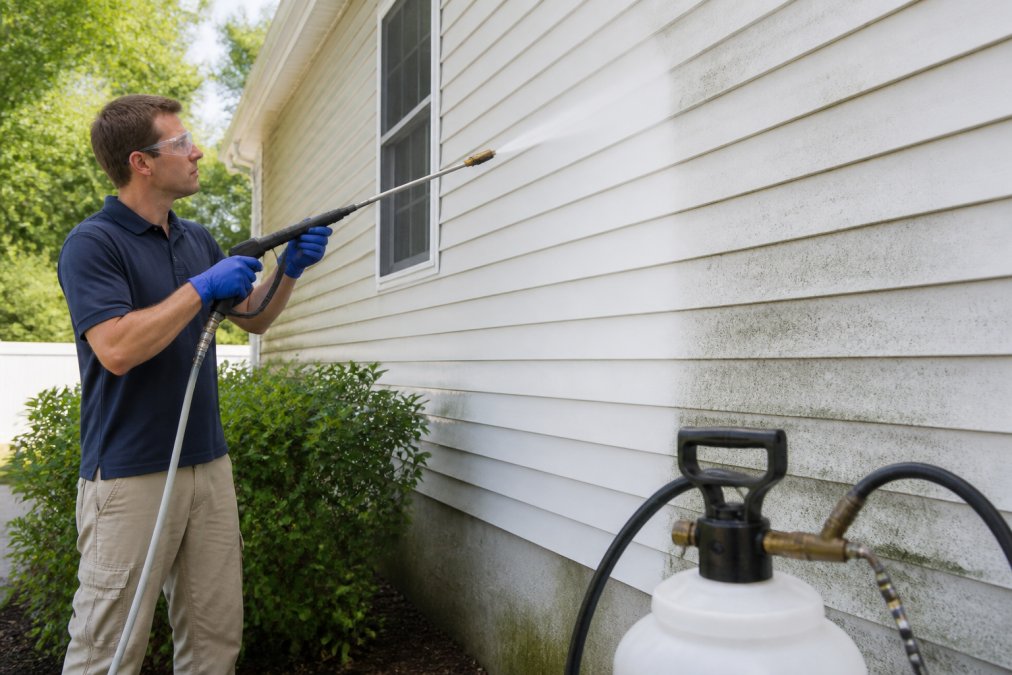
Soft washing vs power washing comes down to one variable: pressure. Soft washing uses low pressure, typically under 500 psi, combined with cleaning solutions to kill organic growth. Power washing uses high pressure, often 2,000 to 4,000 psi, to blast away grime mechanically.
| Surface | Recommended Method | Why |
|---|---|---|
| Vinyl siding | Soft wash | High pressure forces water behind panels |
| Stucco | Soft wash | Pressure cracks and pits the finish |
| Asphalt shingles | Soft wash | Strips granules, voids warranty |
| Concrete driveway | Power wash | Handles high psi without damage |
| Brick (older) | Soft wash | Mortar erodes under pressure |
When Low Pressure Is the Only Safe Option
The rule is simple: if the surface is painted, textured, or layered, low pressure is the only safe option. Mold and mildew on siding, decks, and roofs respond to cleaning solution, not force. A surface cleaner attachment helps on flat concrete, but it won't save a shingle roof from a fan tip held too close.
Pressure Washing Safety Tips for Homeowners
Pressure washing safety tips start with protective gear and end with pressure regulation. Skipping either is how homeowners end up at the emergency room or replacing siding.
Before you pull the trigger:
- Wear safety goggles to protect against flying debris and chemical splash
- Put on closed-toe boots and hearing protection
- Never point the wand at a person or pet
- Check that your extension cord and water supply are rated for the unit
- Test the spray pattern on a hidden area first
The Consumer Product Safety Commission tracks pressure washer injuries each year, and the pattern is consistent: most happen when users lose control of the wand or skip eye protection.
Protecting Plants, Pets, and Runoff
Water runoff carries detergent, degreaser, and loosened grime into soil and storm drains. Pre-wet plants before washing, cover them during the job, and rinse them afterward. Keep pets indoors until the area is dry.
Pressure Washing Cost Calculator: What Drives the Price
A pressure washing cost calculator isn't a fixed formula, but you can build a reliable estimate by breaking the job into measurable units. Most professional exterior cleaning is priced by the square foot, by the linear foot, or by a flat rate per surface type, then adjusted for height, soiling, and access.
Here's how the units typically break down:
- Siding: Priced per square foot of wall area. A single-story home with roughly 1,500 square feet of siding sits in a different tier than a two-story with 3,000 square feet, even if the footprint is identical.
- Driveways and walkways: Priced per square foot of flat concrete. A standard two-car driveway runs about 400 to 600 square feet.
- Roofs: Priced per square foot of roof area, and soft washing a roof usually costs more per square foot than siding because of the chemical mix and the fall-risk setup.
- Decks and fences: Priced per square foot or per linear foot, with an added charge for stripping and re-sealing.
- Gutters: Often priced per linear foot, with a separate line item for brightening the exterior faces.
The main cost drivers:
- Square footage: Larger siding and driveway areas take more time, water, and chemical.
- Surface type: Soft washing roofs and stucco requires more care, more solution, and slower application than flat concrete.
- Access and height: Two-story exteriors need extension wands, ladders, or a lift, and steep rooflines add setup time.
- Level of soiling: Heavy algae, mildew, or oil stains need pre-treatment, dwell time, and a second rinse cycle.
- Frequency: Routine exterior maintenance costs less per visit than a one-time deep clean, because light buildup needs less chemical and less dwell time.
How to Build Your Own Estimate
You don't need a proprietary calculator to get a ballpark. Measure the surfaces you want cleaned, note the material and number of stories, and multiply by a per-unit rate. Most homeowners find that the total lands in a range rather than a single number, because two homes of identical size can differ on access, soiling, and how much prep the job needs.
A few practical shortcuts:
- Measure wall area by multiplying the perimeter of your home by its height, then subtract roughly 15 percent for windows and doors.
- Measure flat concrete by length times width.
- Add a surcharge in your head for anything above the first story, anything painted, and anything with visible organic growth.
Because pricing varies this much by property, the honest answer is that you need a quote. A2Z Wash Pros offers a free quote.
DIY vs Hiring a Pro: Rental ROI and Real Risks
Equipment rental vs purchase ROI is where DIY math gets interesting, and it's worth running the numbers before you commit either way.
Renting: A weekend rental of a gas pressure washer typically runs a fraction of the purchase price, and the rental shop usually includes the wand, hose, and a set of nozzles. For a single driveway or a one-time siding wash, rental almost always wins on pure dollars.
Buying: An entry-level electric unit costs less than a mid-grade gas unit, but electric units generally top out well below the pressure needed for serious concrete work. A gas unit that can handle a driveway and siding pays for itself only if you'll use it several times a year, or if you'll also use it for fences, decks, vehicles, and gutters.
The break-even question: If you'll wash your exterior once and never touch the machine again, rent. If you'll wash your exterior, a driveway, a fence, and a deck over the next two years, the purchase math starts to favor buying, because rental fees stack up fast.
The catch isn't the equipment. It's the damage.
A common mistake is assuming that renting a unit to power wash house surfaces comes with the knowledge to use it correctly. It doesn't. Etched concrete, stripped deck stain, and cracked stucco all come from user error, not bad machines. Those repairs cost far more than the rental saved.
DIY makes sense when:
- The surface is flat concrete, like a driveway or sidewalk
- You're comfortable with pressure regulation and nozzle tips
- The job is a single, low-risk area
- You're willing to test the spray pattern on a hidden spot first
Hiring a pro makes sense when:
- Your home exterior has mixed surfaces, like stucco plus wood trim
- You're dealing with a roof, deck, or anything painted
- You're prepping for a real estate listing and need it done right the first time
- You want the work handled without risking property damage
What to Do If You Damage Something
This is the part most guides skip, and it's the part that matters most when something goes wrong.
- Etched concrete: Usually from a fan tip held too close or too long in one spot. Light etching can fade with weathering; deep etching needs grinding or resurfacing.
- Stripped deck stain: Re-stain within a few dry days, before the wood grain raises and absorbs moisture unevenly.
- Cracked or pitted stucco: Stop washing immediately. Small cracks can be patched and repainted; larger areas may need a stucco contractor.
- Water behind siding: Let the wall dry fully, then check for interior moisture or bubbling paint before you seal anything. Trapping moisture behind siding invites mold.
- Stripped paint on wood trim: Prime and repaint the bare spots promptly, because exposed wood weathers fast.
- Recurring algae: Treat with a cleaning solution rather than more pressure. Pressure alone doesn't kill the organism, so it comes back.
What most guides miss is that damage control is time-sensitive. The longer a problem sits, the more expensive the fix, and the more likely a small repair turns into a full replacement.
Post-Wash Maintenance and Damage Troubleshooting
Post-wash maintenance extends how long your cleaning lasts. In humid climates, algae and mold return fastest on north-facing surfaces that stay damp. Most homeowners find that routine cleaning every 12 to 24 months keeps siding and roofs looking fresh, though shaded areas may need attention sooner.
If you spot a problem after washing, act fast:
- Etched concrete: Usually from a fan tip held too close; light etching can fade, deep etching needs resurfacing.
- Stripped deck stain: Re-stain within a few dry days before the wood grain raises.
- Water behind siding: Let it dry fully and check for interior moisture before sealing.
- Recurring algae: Treat with a cleaning solution rather than more pressure.
What most guides miss is that damage control is time-sensitive. The longer a problem sits, the more expensive the fix.
Conclusion
Getting a clean exterior without damage comes down to matching method to surface, and that's harder than it looks once mixed materials and rooflines are involved. A2Z Wash Pros handles professional pressure washing for driveways, roofs, and decks, with fast, reliable service and a free quote before any work starts. Rated 4.6 stars by customers, the team serves residential and commercial properties with expert cleaning that restores curb appeal. Get started with A2Z Wash Pros and protect your home exterior while making it look its best.
Frequently Asked Questions
How much should it cost to have your house power washed?
Pricing depends on square footage, siding material, number of stories, and how much mold and mildew has built up. Most providers quote per project rather than per hour, and a pressure washing cost calculator can give you a rough range before you call. Get at least two or three free quotes and ask what is included, such as detergent, surface cleaner treatment, and plant protection. A2Z Wash Pros offers free quotes for Houston-area homes.
Can I power wash my house myself?
You can handle flat concrete like driveways and walkways with a rented pressure washer, a surface cleaner attachment, and the right nozzle tips. Siding, stucco, and roofs are riskier. Too much water pressure forces water behind vinyl siding, etches concrete, and strips paint. If your home has mold and mildew on stucco or black streaks on shingles, soft washing with a chemical injector and low pressure is safer than a high-pressure spray.
What are the risks of using a pressure washer on siding?
High-pressure spray can crack vinyl siding, force water into wall cavities, strip paint, and damage window seals. On stucco it can pit the surface, and on wood it raises the grain and opens joints. Most siding only needs 500 to 1,500 PSI with a wide fan tip, or a soft wash at garden-hose pressure. Always test a small hidden area first, and keep the nozzle moving to avoid etched marks or streaks.
How often should you power wash your house?
In humid climates like the Houston area, plan on an exterior wash every 12 to 18 months. Homes under heavy tree cover or near water may need it twice a year because algae and mildew return faster. Driveways and decks often need cleaning more often than siding. Regular exterior maintenance keeps curb appeal high and stops organic growth from staining surfaces permanently, which costs more to fix later.