 comparison
Is Soft Wash Roof Cleaning Safe for Asphalt? 2026 Guide
Table of Contents
- What Is Soft Washing and How Does It Work on Asphalt Shingles?
- Soft Washing vs. Pressure Washing: Why PSI Matters for Your Roof
- How to Remove Black Roof Streaks Without Damaging Shingles
- Asphalt Shingle Roof Cleaning Best Practices for Long-Term Results
- How Long Does Soft Wash Roof Cleaning Last?
- Roof Warranty, Chemical Safety, and What Manufacturers Actually Require
- DIY Soft Washing vs. Hiring a Professional: Equipment, Risks, and Costs
- Frequently Asked Questions
Last Updated: September 16, 2026
What Is Soft Washing and How Does It Work on Asphalt Shingles?
Soft washing is a low-pressure exterior cleaning method that relies on specialized cleaning solutions to break down organic growth rather than force. For asphalt shingles, this matters enormously: high pressure strips the protective granule coating that shields the asphalt layer beneath.
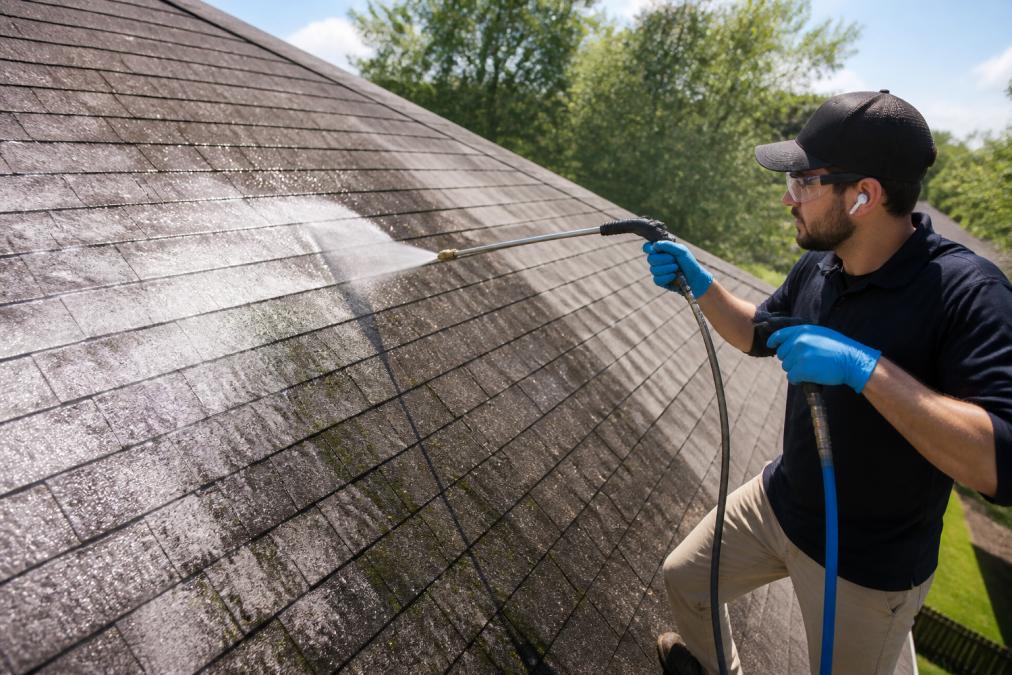
- Pre-treatment with a diluted sodium hypochlorite solution mixed with surfactants
- Chemical dwell time of 10-15 minutes, letting the solution kill algae, moss, and lichen at the root
- Low-pressure rinse at roughly 100-200 PSI to wash away dead organic matter
Soft Washing vs. Pressure Washing: Why PSI Matters for Your Roof
Pressure washing an asphalt roof is one of the fastest ways to cause premature failure. Standard equipment runs 2,000-4,000 PSI; shingles are engineered to withstand rain, wind, and hail, not a directed jet at 40 times atmospheric pressure.
| Method | Pressure Range | Effect on Granules | Warranty Risk |
|---|---|---|---|
| Pressure washing | 2,000-4,000 PSI | Strips granules, causes impact damage | High |
| Soft washing | 100-200 PSI | Preserves granule retention | Low |
How to Remove Black Roof Streaks Without Damaging Shingles
Black streaks are almost always gloeocapsa magma, an algae that feeds on the limestone filler in asphalt shingles. Streaks start small near the ridge and spread downward as spores wash across the surface.
Removing them safely follows a specific sequence:
- Identify the growth type. Black streaks suggest algae. Green fuzz indicates moss. Crusty gray-green patches point to lichen.
- Apply a sodium hypochlorite solution at a concentration appropriate for the shingle age and growth severity.
- Allow adequate chemical dwell time so the solution penetrates and kills the organism.
- Rinse at low pressure, working top to bottom.
- Manage runoff to protect landscaping and prevent cleaning solution from entering storm drains.
Asphalt Shingle Roof Cleaning Best Practices for Long-Term Results
Durable results come from method, timing, and follow-through. A few practices separate a cleaning that lasts from one that fades by the next rainy season.
How Long Does Soft Wash Roof Cleaning Last?
A properly executed soft wash typically keeps a roof clean for one to three years, depending on climate, shade, and tree cover. Shaded homes see regrowth sooner because moisture lingers on the shingle surface.
Roof Warranty, Chemical Safety, and What Manufacturers Actually Require
Asphalt shingle warranties cover manufacturing defects, not maintenance damage, and improper cleaning is one of the most common reasons a claim gets denied.
What the warranties actually say
Major shingle manufacturers, including those behind the common 25-, 30-, and 50-year limited warranties, publish maintenance language requiring the roof be kept free of organic growth and debris while prohibiting "damage caused by improper maintenance" or "use of harsh chemicals or high-pressure washing." Wording varies by brand, so pull the actual warranty PDF for your shingles and read the maintenance clause.
A few patterns show up across most of them:
- Pressure washing is almost universally excluded. High-pressure water that strips granules or fractures the mat is treated as owner-caused damage, not a defect.
- Chemical damage is also excluded. Using a solvent, undiluted bleach, or a caustic cleaner that oxidizes the asphalt or bleaches the granule color can void coverage for the affected area.
- Improper application matters as much as the chemical. Over-application, letting solution pool in valleys, or rinsing too soon so the growth returns can all be cited in a denial.
- Documentation helps. Keeping the receipt from a licensed soft wash contractor, or photos of the roof before and after, gives you something to point to if a claim is ever questioned.
Before you hire anyone, ask for the shingle brand and product line, then read that manufacturer's maintenance clause yourself. A contractor who can't tell you which warranties their method complies with is a contractor who hasn't read them.
Chemical safety: the numbers that matter
Sodium hypochlorite is sold at different strengths, and the label strength isn't what hits your roof. Consumer bleach is typically 6% to 8.25%; professional solutions are diluted from 10% or 12.5% stock. The mix on the shingles is usually 1% to 3%, adjusted for growth severity and shingle age.
What you should never do:
- Never mix sodium hypochlorite with ammonia, vinegar, or any acid-based cleaner. The reaction releases chlorine gas, which is dangerous in any concentration and can be fatal in an enclosed space.
- Never apply it at full stock strength to a shingle roof. Undiluted hypochlorite oxidizes the asphalt and can bleach the granule color permanently.
- Never let it pool. Solution that sits in a valley or against a wall for too long can damage flashing, paint, and the shingles themselves.
Protective gear and site protection
Anyone applying the solution needs chemical-resistant gloves (nitrile, not latex), sealed eye protection, and respiratory coverage in still air or confined spaces. Pre-wet landscaping, cover sensitive plants and furniture, and never let runoff flow into a storm drain or koi pond. Most municipalities treat roof-cleaning runoff as a regulated discharge, so directing it onto a lawn or gravel bed is both practical and compliant.
If you can smell chlorine strongly while you're working, you're breathing it. Step back, let the area ventilate, and check that your mix ratio and your PPE are right before continuing.
Why this is the section that separates a safe clean from a costly one
A soft wash that kills growth at the root and preserves granules is a maintenance event. One that uses the wrong strength, skips dwell time, or lets solution pool is a damage event, exactly what warranty administrators look for when a claim is filed years later. Getting the chemistry and paperwork right up front keeps the roof covered.
DIY Soft Washing vs. Hiring a Professional: Equipment, Risks, and Costs
DIY soft washing is possible. Whether it's safe for your asphalt shingles depends on your equipment and how you use it. Most homeowner failures trace to one of two things: a pressure washer that's too strong, or a pump sprayer that can't deliver an even, controlled application.
What consumer-grade equipment can and can't do
What works for a homeowner:
- A backpack or pump sprayer rated for bleach-compatible chemicals (check the seals, standard rubber degrades quickly with hypochlorite). A 1- or 2-gallon sprayer handles spot treatment on a small, low-slope section.
- A garden hose with a standard nozzle for the rinse, roughly the same pressure range as a professional soft wash rinse: low, even, controllable.
- A downstream injector on a hose-end sprayer, which siphons diluted solution into the stream at a set ratio, the closest a homeowner gets to a pro setup without a dedicated unit.
What does not belong on a roof:
- Any gas or electric pressure washer rated above roughly 1,500 PSI. Even a "low-pressure" consumer electric unit is usually 1,300-1,800 PSI at the nozzle, which is still enough to strip granules at close range.
- Rotary or turbo nozzles of any kind. These concentrate the stream and cause impact damage regardless of the machine's rated PSI.
- Standard pump sprayers with unknown seals. If the manufacturer doesn't list the sprayer as bleach-compatible, the seals will fail mid-job and you'll be handling concentrated solution with a leaking tool.
A realistic DIY kit, bleach-compatible sprayer, downstream injector, hose-end nozzle, nitrile gloves, sealed eye protection, respirator, runs in the low hundreds of dollars. The hidden cost is the roof itself: walking asphalt shingles, especially in summer heat when they soften, causes foot traffic damage no warranty covers.
The fall-risk math
Roof work is one of the most dangerous categories of residential labor, and falls are the leading cause of serious injury in home maintenance. If your roof needs a ladder taller than one story, has a pitch steeper than about 6:12, or has any section you can't reach from a stable standing position, the equipment savings stop mattering.
What professional equipment actually adds
Professional soft wash rigs use a dedicated low-pressure pump (often 12-volt or gas-driven) delivering solution at a consistent, adjustable rate, typically 40-100 PSI at the nozzle, well below the damage threshold. Even coverage means even kill, so growth doesn't return in patches. Some operators use drone-mounted spray systems for steep or fragile roofs, removing foot traffic entirely.
Cost comparison over a few seasons
A professional soft wash on a typical single-family asphalt shingle roof generally runs several hundred dollars, varying with size, pitch, and growth severity. A failed DIY attempt, weak mix, short dwell time, aggressive rinse, costs the same in materials plus a weekend of labor, then has to be redone. Over two or three seasons, the professional clean is often cheaper and keeps the warranty intact.
Ask any contractor two questions before you hire: what PSI does your equipment deliver at the nozzle, and what concentration of sodium hypochlorite are you applying? A pro who can answer both without hesitating is a pro who understands the method. A pro who can't is guessing on your roof.
The bottom line on DIY
If you have a single-story, low-pitch roof, a small area of light algae, and the patience to mix and apply carefully, DIY soft washing with the right tools is reasonable. If your roof is steep, tall, heavily grown, or under a warranty you'd rather not risk, hire a professional, the cost difference over a few seasons is smaller than it looks.
Frequently Asked Questions
Can soft washing strip granules from asphalt shingles?
Soft washing uses low pressure, typically 100 to 200 PSI, which is well below the threshold that dislodges granules. Granule loss happens when high-pressure water, often 3,000 PSI or more, blasts the shingle surface. The cleaning solution does the work in soft washing, not force. As long as the technician follows proper dilution ratios and keeps the nozzle at a safe distance, granules stay intact and the shingle coating remains protected.
How do I remove black roof streaks without damaging my shingles?
Black streaks come from gloeocapsa magma, an algae that feeds on limestone filler in asphalt shingles. The safe approach is a soft wash using sodium hypochlorite mixed with surfactants, applied at low pressure, then rinsed after proper chemical dwell time. Never use a pressure washer directly on shingles. A professional soft wash roof cleaning service can remove the streaks completely while preserving granule retention and roof integrity.
How long does soft wash roof cleaning last before streaks return?
Results typically last one to three years, depending on your climate and tree coverage. In humid areas with frequent rain and shade, algae spores return faster. Most homeowners schedule professional cleaning every 18 to 24 months to stay ahead of regrowth. Post-cleaning maintenance, like trimming overhanging branches and keeping gutters clear, can extend the clean appearance and delay the next service.
Is soft washing better than high-pressure washing for asphalt roofs?
Yes. High-pressure washing forces water under shingle edges, loosens granules, and can void manufacturer warranties. Soft washing relies on biodegradable cleaning solutions and a low-pressure rinse cycle to kill organic growth at the root. It cleans deeper and lasts longer without impact damage. For asphalt shingles, soft washing is the only method most roofing manufacturers recommend.
Do I need to rinse the roof after soft washing?
Yes, a low-pressure rinse is a critical step. After the cleaning solution sits for the required dwell time, usually 10 to 20 minutes, the technician rinses the roof to remove dead organic matter and residual chemicals. Skipping the rinse cycle can leave a sticky film that attracts new algae spores and may harm plants or runoff areas. Proper rinsing also ensures a clean, streak-free finish.